Panels get most of the attention, but the inverter is what makes solar power usable. It converts the direct current your panels produce into the alternating current your home runs on. It is also the component most likely to fail first.
The type you choose affects what the system costs, how it handles shade and snow, and what service looks like ten years from now. Here is how the two main options compare for Ohio homes.
How Each Type Works
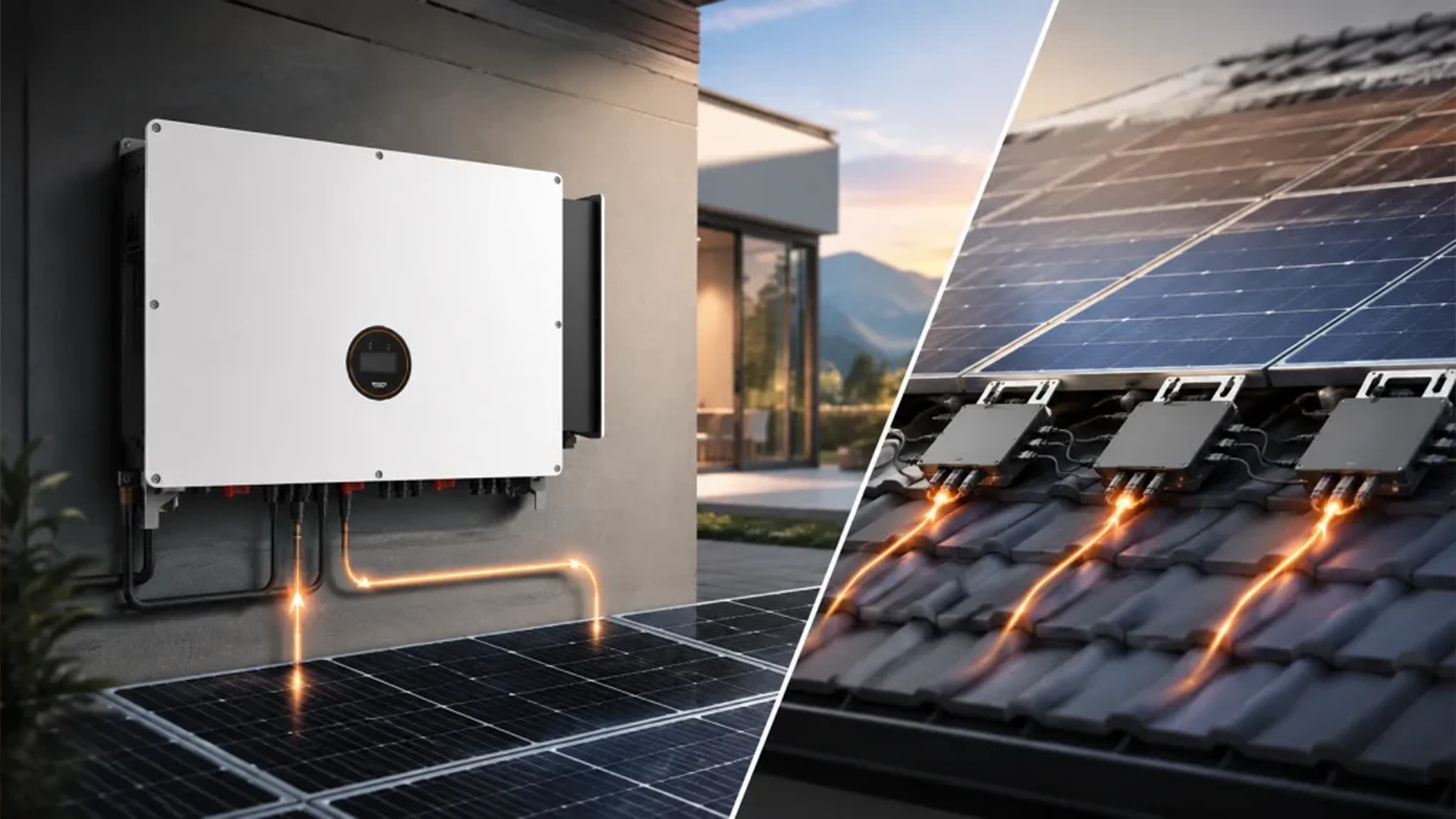
A string inverter is a single box, usually mounted on a garage wall or near the main electrical panel. Panels are wired together in series, in groups called strings, and their combined DC power travels to that one unit for conversion.
Microinverters move the job up to the roof. A small inverter sits beneath each panel and converts power on the spot, so every module works independently.
Power optimizers sit in between. They attach to each panel for better shade tolerance and panel-level monitoring, then send DC power to one central inverter.
String Inverter Advantages and Disadvantages
String inverters cost less up front, and their location is a real advantage during service. When one fails, a technician replaces a single unit at ground level without touching the roof. They also pair well with batteries. A hybrid string inverter, such as those used in Sol-Ark battery backup systems, manages the panels and storage from one box.
That same single-unit design also creates weaknesses. Panels in a series string tend to perform at the level of the weakest one, so shade on one or two modules can pull down the whole string. If the inverter stops, the entire array stops with it. Lifespan is the other drawback. String inverters typically last 10 to 15 years, and warranties often run 5 to 12 years, while panels can produce for 25 years or more. Most owners should expect to replace a string inverter at least once.
Benefits of Microinverters for Solar Panels
Because each panel runs on its own, a shaded or snow-covered module affects only itself. That matters in Ohio, where mature trees, chimney shadows, and patchy winter snow are common, and where many homes split panels across east- and west-facing roof planes. Microinverters handle those mixed conditions well.
You also get monitoring for every panel, so a problem shows up as one underperforming module instead of a vague dip in total output. A single failure takes one panel offline, not the system. Warranties are long, too. Enphase backs its IQ8 microinverters with a limited warranty of up to 25 years.
Code compliance is simpler as well. Ohio’s current electrical code, based on the 2023 National Electrical Code, requires rapid shutdown for rooftop arrays. Microinverters meet that requirement by design, while most rooftop string systems need optimizers or separate shutdown devices.
The trade-offs are cost and access. Microinverters cost more, and replacing one means a technician on the roof.
Microinverter Efficiency for Home Solar Systems
On paper, conversion efficiency is close to even. Enphase rates its IQ8 microinverters at 97% CEC-weighted efficiency, and quality string inverters land in the same range.
The real difference is yearly energy harvest. On an unshaded, single-plane, south-facing roof, a string inverter will produce about as much. Add shade, several roof angles, or uneven snow, and microinverters usually come out ahead.
String Inverter vs. Microinverter Cost
According to SolarReviews’ 2026 pricing guide, string inverters generally run $1,000 to $3,000 per unit, while microinverters cost $150 to $250 per panel. Overall, microinverter systems tend to cost $0.25 to $0.45 more per watt. On an 8 kW home system, that works out to roughly $2,000 to $3,600 more at installation.
Lifespan narrows the gap. A string inverter will likely need replacing once over the panels’ lifespan, while microinverters are built to last about as long as the array. Upfront cost carries more weight than it did a few years ago, since the federal residential solar tax credit ended for homeowner-owned systems installed after 2025.
When Your Inverter Needs Replacing
Many Ohio systems installed in the early 2010s have reached the age when string inverters wear out. Warning signs include error codes, a blank display, a red status light, or monitoring that shows production falling or stopping.
Diagnose before you replace. The fault may be in the wiring, a tripped breaker, or a failed monitoring gateway, not the inverter itself. If the inverter is finished, you have choices. A like-for-like swap is the fastest fix. Upgrading to a hybrid inverter adds battery backup. Switching to microinverters or optimizers makes sense if shade has always cut into your output, though it means roof work and rewiring.
Whichever path you take, the new equipment has to match your panels’ voltage and current and meet your utility’s interconnection requirements. Professional inverter service and replacement covers that compatibility check, so the new unit works with the array you already own.
Which Is the Best Solar Inverter for Residential Use in Ohio?
There is no single winner. A string or hybrid inverter is usually the better value for a simple, unshaded roof, especially if battery storage is part of the plan. Microinverters earn their higher price on shaded or complicated roofs and for homeowners who want panel-level monitoring and a long warranty. Optimizers sit between the two.
An on-site assessment of shading, roof layout, and your existing electrical equipment will point to the right choice faster than any spec sheet.
Frequently Asked Questions
What is the difference between a string inverter and a microinverter?
A string inverter converts power for a group of panels in one central unit. Microinverters convert power at each panel.
Are microinverters more efficient than string inverters?
Conversion efficiency is similar, around 97% for leading models. Microinverters usually harvest more energy on shaded or multi-angle roofs.
Which is more affordable: string inverters or microinverters?
String inverters typically cost $0.25 to $0.45 per watt, though they usually need one replacement during the panels’ lifespan.
Are microinverters better for solar panels with partial shading?
Yes. Shade on one panel affects only that panel, not the whole string.
Which inverter type is best for residential solar systems in Ohio?
Simple, unshaded roofs often suit a string or hybrid inverter. Shade, multiple roof faces, and uneven snow favor microinverters or optimizers.